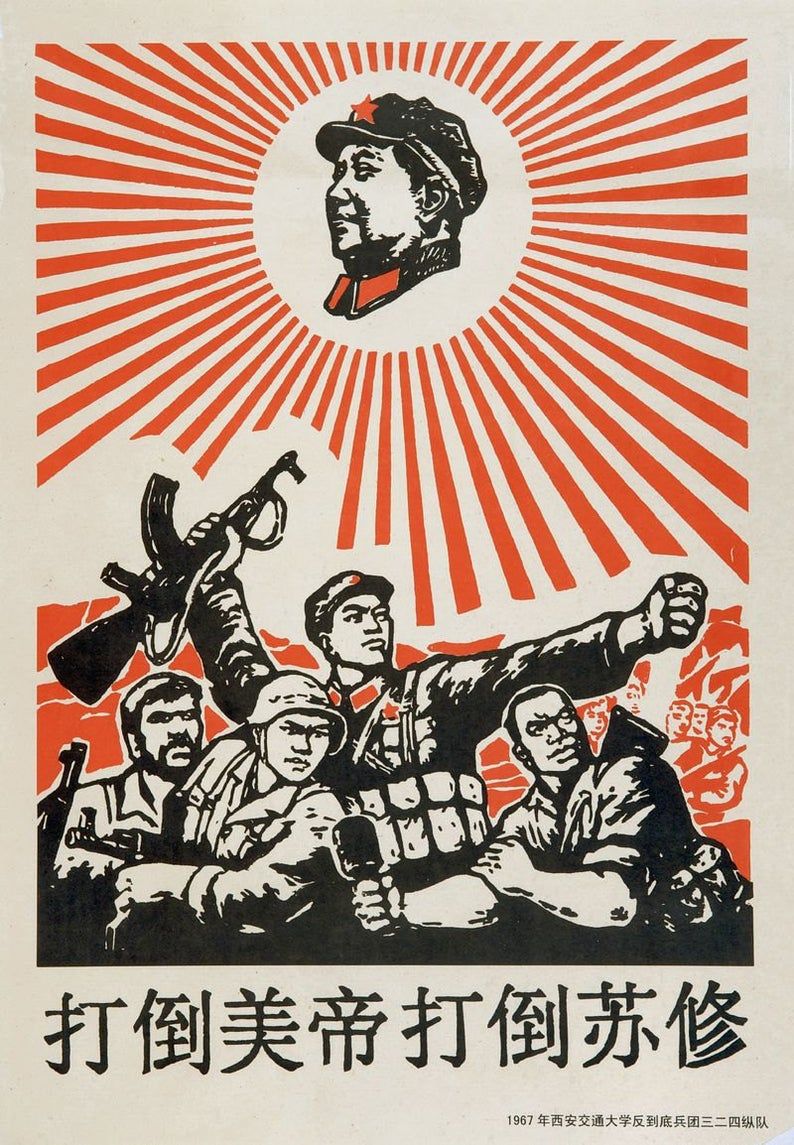

We are often criticised by Maoists, or those at least sympathetic to Mao, as being nitpickers subjecting real revolutions to unrealistic purity tests. They say that in doing so, we effectively side with western imperialism, and fail to recognise the heroic anti-imperialist work of Mao and the Chinese Communist Party.
If Mao was such an exemplar of anti-imperialism, how do we explain the Sino-Soviet Split, in which the world’s two largest planned economies fought against one another instead of uniting against imperialism? How do we explain Mao’s resulting embrace of Nixon and the precursor to the EU as part of his struggle with the USSR?
Why did these strange events take place, and what do they tell us about ‘Socialism in One Country? Why does Mao have such a strong reputation as an anti-imperialist if he collaborated with imperialist countries? Is China’s rise as an imperialist power a contradiction of Maoism, or a logical consequence? What are the relevant lessons for today’s epoch of imperialist proxy wars and the rise of China as imperialist? This talk by Daniel Morley will answer all these questions and more.
Reading list
Books
- John Roberts – “China: Permanent Revolution to Counterrevolution” (English)
- V. I. Lenin – “Imperialism: The Highest Stage of Capitalism” (English) (Spanish) (French) (German) (Portuguese)
Articles
- Parson Young – “The myth of Mao’s ‘anti-imperialism’” (English)
- Ted Grant – “Nixon-Mao—What Talks Mean” (English)
- Alan Woods and Ted Grant – “Lenin and Trotsky: What they Really Stood For” Chapter 8 (English)
- Leon Trotsky – “The Third International After Lenin” Part 3 (English)
- Jules Legendre – The 1949 Chinese Revolution (French)
- Marxism vs Maoism (French)
Podcasts
- Spectre of Communism – “The truth about Mao and the Chinese Revolution” (English)
Videos
- Jules Legendre – Maoism vs Marxism: Understanding the Chinese Revolution (French)